Building Solana DEX Execution Engine
High-Performance Order Execution System for Solana DEXs
The Task
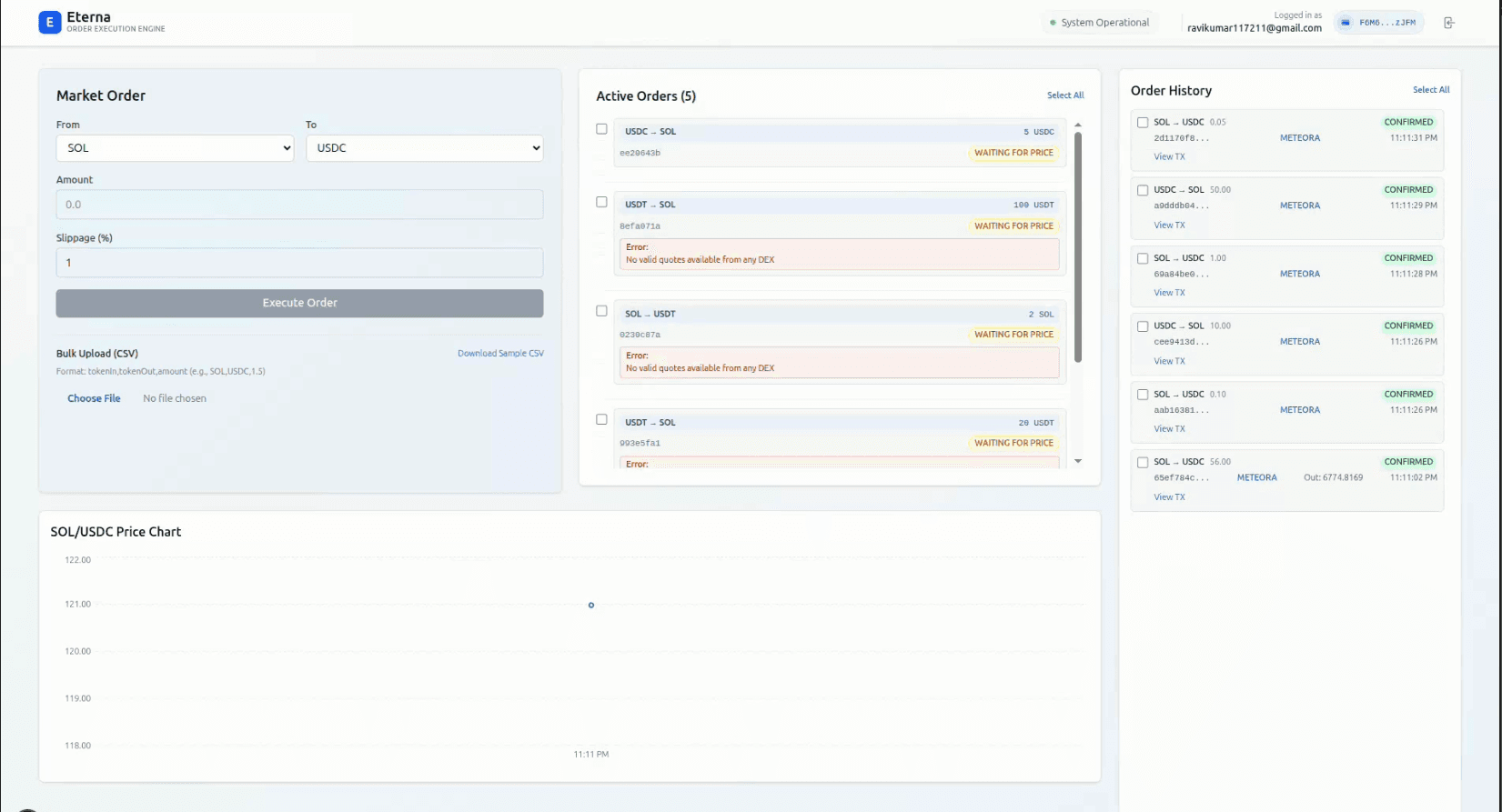
The goal was to build an order execution engine for Solana DEXs that processes market orders with real on-chain execution (not simulated). The system needed to handle DEX routing between Raydium and Meteora, provide real-time status updates via WebSocket, and process concurrent orders using a queue system.
Key Requirements:
- Execute actual swaps on Solana Devnet using Raydium and Meteora SDKs
- Compare prices from both DEXs and route to the better one
- Handle 100 orders/minute with 10 concurrent workers
- Implement retry logic (max 3 attempts with exponential backoff)
- Stream order status updates (pending → routing → building → submitted → confirmed/failed)
- User authentication and order history
Implementation
This engine is built with Next.js 15 as a full-stack application. Orders are submitted via REST API, added to a BullMQ queue backed by Redis, and processed by worker threads that interact with Raydium and Meteora SDKs. All transactions are executed on Solana Devnet and can be verified on Solana Explorer.
Key Features:
- REST API endpoints for order submission and history
- BullMQ worker that fetches quotes from both DEXs in parallel
- DEX router that compares prices and selects the optimal DEX
- Transaction builder for Raydium and Meteora swaps
- Socket.IO server for broadcasting status updates
- PostgreSQL database with Drizzle ORM for persistence
- JWT authentication for user sessions
Real On-Chain Execution
Executes actual swaps on Solana Devnet using @raydium-io/raydium-sdk-v2 and @meteora-ag/dynamic-amm-sdk. Each transaction gets a signature that can be verified on Solana Explorer.
BullMQ Queue System
Orders are processed asynchronously by workers (max 10 concurrent). Failed transactions retry up to 3 times with exponential backoff (2s, 4s, 8s delays). Queue persists in Redis.
DEX Price Comparison
Worker fetches quotes from Raydium and Meteora simultaneously. Compares output amounts and routes the order to whichever DEX gives more tokens. Routing choice is logged to database.
Real-Time Status Updates
Socket.IO broadcasts order status changes as they happen: pending, routing, building, submitted, confirmed, or failed. Client receives updates with <100ms latency.
How It Works
Pending → Queue Entry
Order submitted via POST /api/orders/execute. System generates orderId, saves to PostgreSQL, pushes job to BullMQ queue, and returns WebSocket URL. Status: pending.
Routing → Price Discovery
Worker fetches quotes from both Raydium and Meteora in parallel. Compares output amounts, selects best DEX, logs routing decision. Status update streamed via Socket.IO. Status: routing.
Building → Transaction Creation
Worker creates swap instruction for chosen DEX, handles wrapped SOL if needed, adds 1% slippage protection, and builds the complete transaction. Status: building.
Submitted → On-Chain Execution
Transaction sent to Solana Devnet RPC. Worker gets transaction signature immediately and broadcasts it to client. User can track on Solana Explorer in real-time. Status: submitted.
Confirmed/Failed → Settlement
Worker waits for finalization. On success: extracts execution price, updates DB with txHash, emits 'confirmed'. On failure after 3 retries: saves error, emits 'failed'.
Technical Architecture
Full-Stack
Next.js 15 + TypeScript
Database
PostgreSQL (Drizzle ORM)
Queue & Cache
Redis + BullMQ
Blockchain
Solana Web3.js + DEX SDKs
Built With Modern Technologies
System Architecture
HTTP + WebSocket Pattern
REST endpoint for order submission returns immediately with orderId. Client establishes WebSocket connection for status streaming. Decouples submission from execution—no blocking, no timeouts.
Distributed Queue with BullMQ
Redis-backed job queue handles concurrent processing (10 workers). Each order is a job with automatic retries (max 3 attempts, exponential backoff: 2s, 4s, 8s). Queue persistence survives crashes.
Parallel Quote Fetching
Worker initializes both Raydium and Meteora SDKs concurrently. Fetches quotes in parallel (200ms each). Compares output amounts and selects DEX with higher return. Routing decision logged to PostgreSQL.
Real Devnet Execution
No mocks, no simulations. Worker builds actual swap transactions using SDK methods, signs with server keypair, submits to Solana Devnet RPC, and confirms on-chain. Every txHash is verifiable on Solana Explorer.
Database Schema (Drizzle ORM)
Users table with JWT auth. Orders table tracks full lifecycle: orderId, userId, tokens, amounts, status, selectedDex, txHash, error. Type-safe queries with Drizzle prevent SQL injection and runtime errors.
Status Streaming via Socket.IO
Worker emits events to Socket.IO server after each status change. Server broadcasts to clients subscribed to that orderId. Sub-100ms latency ensures users see status updates in real-time.
Technical Challenges
- Integrating Raydium SDK v2 and Meteora SDK - different APIs, different pool structures
- Handling wrapped SOL for native token swaps (required extra transaction steps)
- Managing concurrent order processing without hitting RPC rate limits
- Implementing exponential backoff retry logic that doesn't retry forever
- Coordinating WebSocket updates between worker threads and API server
- Database schema design for tracking order lifecycle and routing decisions
Check Out the Code
The full source code, documentation, and deployment guide are available on GitHub. Includes API documentation, database schema, and example transactions on Solana Explorer.