Surviving The DDoS Wave
Holding the line against 230k requests per IP.

The Attack
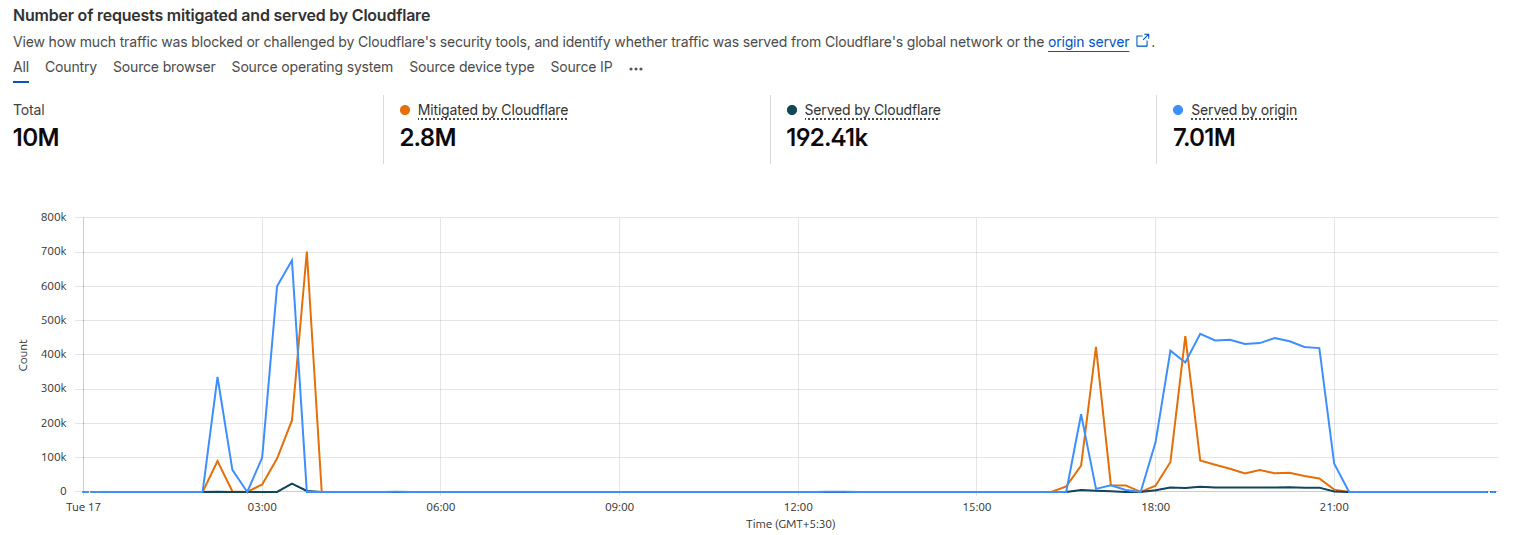
It started like any other week, until the traffic graphs hit the roof. The attack began as a broad wave from South Asian botnets, averaging around 153k requests per IP. But quickly, it shape-shifted.
The attackers pivoted to highly targeted Eastern European floods. At its peak, we recorded an insane 233,780 requests/IP coming from networks like Magti-BROADBAND in Georgia. They weren't just probing; they were trying to punch a hole straight through our origin server.
| IP Address | ASN / Org | Country | Total Requests |
|---|---|---|---|
| 94.240.207.152 | AS16010 Magticom Ltd. | GE | 1.48M |
| 95.137.180.45 | AS34797 System Net Ltd | GE | 1.32M |
| 176.221.148.222 | AS35805 JSC "Silknet" | GE | 1.30M |
| 223.181.10.105 | AS24560 Bharti Airtel Ltd. | IN | 154.08k |
| 122.178.131.191 | AS24560 Bharti Telenet Ltd. | IN | 138.19k |
Why Standard Defenses Failed
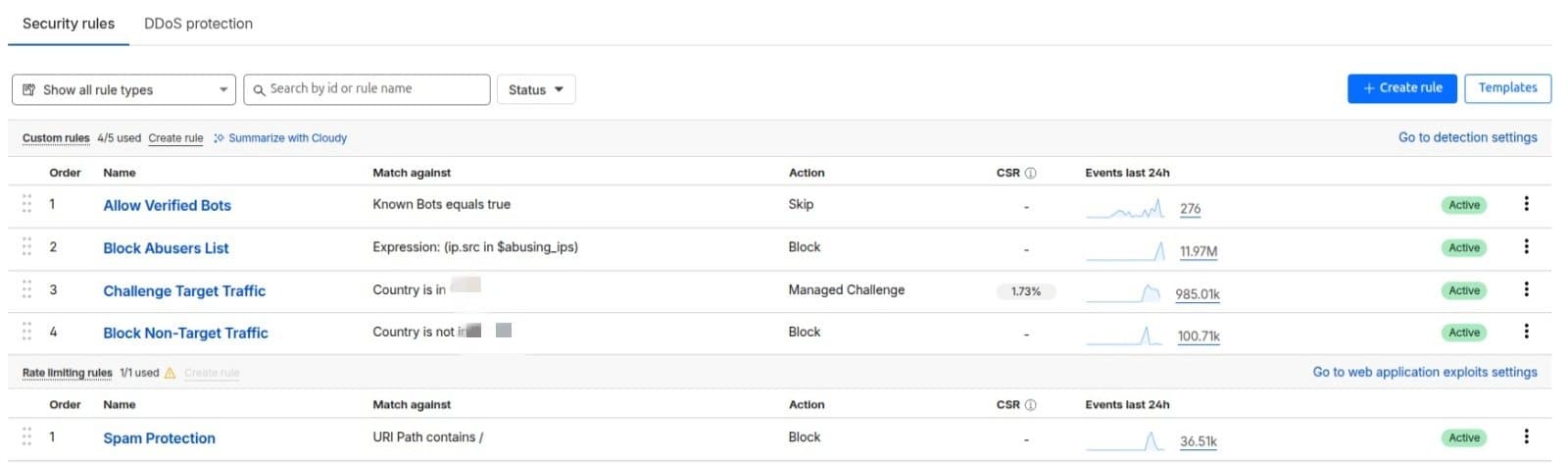
Our initial reaction was to rely on built-in safeguards. We turned on Cloudflare's "I'm Under Attack" mode and deployed aggressive Rate Limiting (500 req/min). It wasn't enough.
- The Rate Limit Bypass: Because the botnet was so highly distributed across tens of thousands of unique residential IPs, individual nodes stayed quietly under the 500 req/min limit. As a result, over 2 million malicious requests bled directly through the filters to our origin.
- The SEO Collateral Damage: Leaving "Under Attack" mode on acted as a blunt instrument. While it caught some unsophisticated bots, it completely blocked Googlebot from fetching pages and destroyed our social media link previews (like WhatsApp). It simply couldn't be a permanent solution.
The Dilemma
When infrastructure is hit with this much traffic, the instinct is to drop the hammer: just block the entire ASN. But that's a trap. Recent large and powerful botnets are increasingly using IPs from major retail ISPs (like AT&T, Comcast, and equivalent regional providers). Because of this, it's virtually impossible to block ASNs without immediately dropping thousands of legitimate users who share those same networks.
We had to hold the line with pinpoint IP-level blocking.
Holding The Line
We leaned heavily on the Cloudflare WAF. We manually identified the top offending IPs and added them to custom block lists to drop the traffic right at the edge. By blocking at the IP level rather than the ASN level, the site stayed up and legitimate traffic flowed perfectly fine.
Peak Throughput
233,780 requests per IP hitting the edge layer.
Origin Survival
Origin latency remained unaffected due to edge-level drops.
The Realization
While we survived, I realized something important: manually blocking hundreds of IPs while under fire is absolutely exhausting.
Cloudflare's real-time rate limiting is powerful, but running it on every single request gets incredibly expensive. There had to be a way to automate IP reputation checks based on analytics, dropping bad actors into custom WAF lists automatically without paying a massive premium. So, I decided to build it myself.